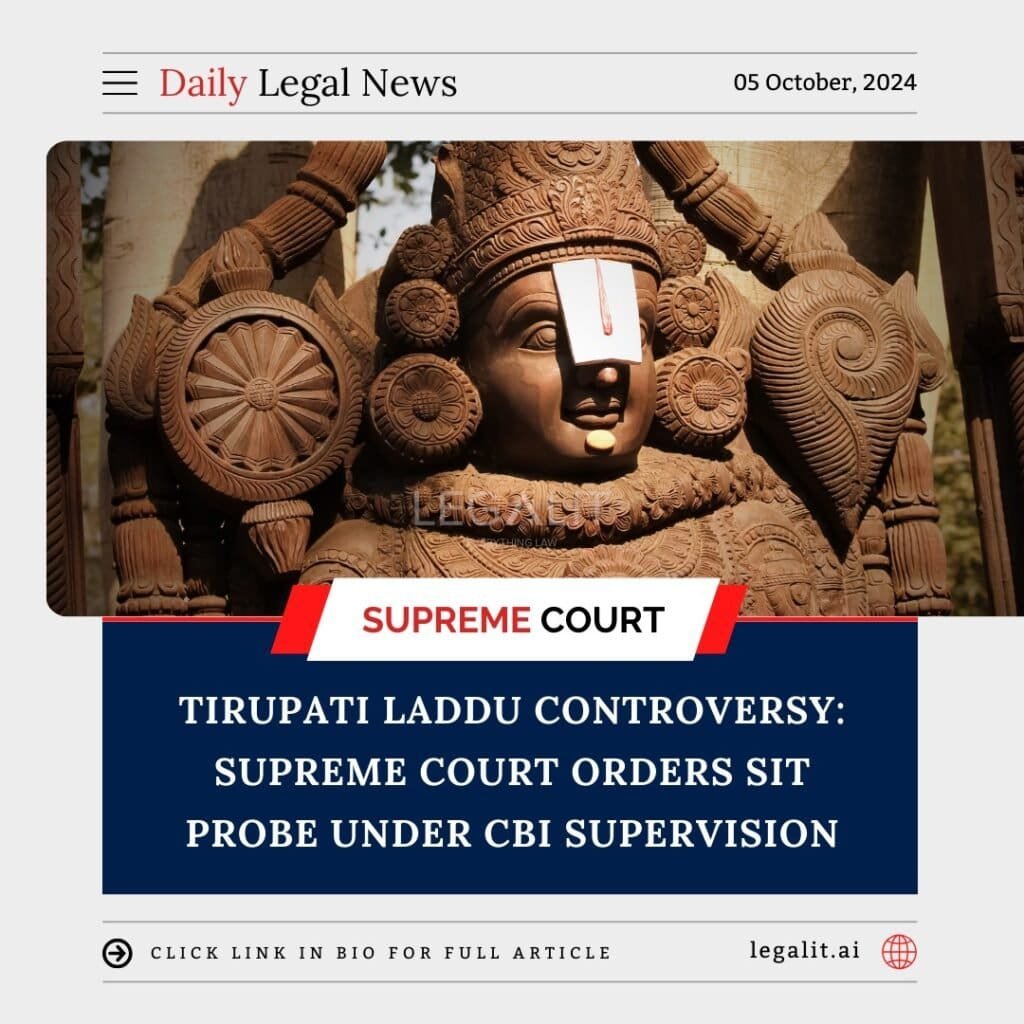
The recent Supreme Court directive to probe the Tirupati Laddu controversy has stirred considerable attention, particularly given the involvement of the Central Bureau of Investigation (CBI). The controversy revolves around allegations concerning irregularities related to the sacred Tirupati Laddu, a renowned offering of the Tirumala Tirupati Devasthanams (TTD). The Court’s decision to establish a Special Investigation Team (SIT) under CBI supervision reflects the seriousness of the allegations and the need for a thorough and impartial investigation.
- Background of the Case
The Tirupati Laddu, often referred to as “Srivari Laddu,” is an iconic religious offering from the Tirumala Tirupati Devasthanam, one of the most visited pilgrimage sites in India. This sacred offering is deeply cherished by millions of devotees and is a symbol of the sanctity of the temple.
In recent times, allegations have surfaced regarding the quality and production processes of the Laddu, leading to questions about potential mismanagement and misconduct by officials associated with the Tirumala Tirupati Devasthanams. Concerns about the use of substandard ingredients and the unauthorized sale of Laddus in the black market have led to growing discontent among devotees and calls for accountability.
The issue escalated when complaints were filed, alleging that some officials were exploiting the production of these religious offerings for personal profit. The involvement of politically connected individuals in the procurement and supply chains added to the complexity and sensitivity of the matter.
- Supreme Court’s Ruling and Reasoning
In response to these allegations, the Supreme Court ordered the formation of a Special Investigation Team (SIT) to conduct an in-depth inquiry into the matter, operating under the supervision of the CBI. The Court emphasized the need for an impartial and unbiased investigation, given the seriousness of the charges and the widespread public concern regarding the sanctity of the religious offering.
The Supreme Court, while issuing the order, highlighted that any deviation from standard practices in the preparation and distribution of a sacred offering like the Tirupati Laddu could not be taken lightly. The bench observed that the allegations, if found true, could significantly undermine the trust of millions of devotees in the administration of the temple.
The decision to place the investigation under CBI supervision was driven by the need to ensure transparency and accountability. The CBI, being a central investigative agency, is seen as better equipped to handle cases with political and financial complexities, thus assuring a fair probe without any undue influence.
- Implications of the Judgment
The Supreme Court’s decision to order an SIT probe under CBI supervision has several important implications:
Restoration of Public Trust: One of the primary aims of the investigation is to restore the trust of millions of devotees in the sanctity of the Tirupati Laddu and the integrity of TTD officials. Any deviation in maintaining the quality of the sacred offering could erode the faith of the devotees, which the Court has recognized as a serious concern.
Accountability in Temple Administration: The case sets a precedent for greater accountability in the administration of religious institutions, particularly in cases involving significant public trust and finances. The investigation will likely scrutinize procurement practices, financial transactions, and the roles of specific officials, aiming to establish whether corruption was involved.
Role of the CBI in Religious Matters: By involving the CBI, the Court has underscored the seriousness with which such matters involving religious institutions should be treated. This move may lead to more such interventions in cases where allegations of corruption or misconduct in temple administrations come to light.
- Need for Reforms in Temple Administration
The Tirupati Laddu controversy has highlighted a broader issue concerning the administration of religious institutions in India. There is a pressing need for reforms to ensure transparency, prevent financial irregularities, and maintain the sanctity of religious practices:
Independent Oversight Bodies: Establishing independent bodies to oversee the administration of temples, including procurement, financial transactions, and management of religious offerings, could go a long way in preventing misconduct. Such bodies should include experts in finance, ethics, and representatives from the devotee community.
Transparency in Procurement: Ensuring transparency in the procurement of ingredients and the production process of religious offerings is crucial. Standard procedures should be put in place for audits and third-party quality checks, with periodic reports made available to the public.
Accountability of Officials: Temple administrators should be held to high standards of accountability, given the public trust placed in them. Any evidence of malfeasance should lead to strict disciplinary actions, including removal from office and criminal prosecution if warranted.
Conclusion
The Supreme Court’s directive to order an SIT probe under the supervision of the CBI into the Tirupati Laddu controversy reflects a commitment to ensuring transparency and maintaining the sanctity of religious institutions. As the investigation progresses, it will be critical to address not only the specific allegations but also the systemic issues that allowed such a situation to arise.
Ensuring the integrity of the Tirupati Laddu is about more than just addressing quality concerns; it is about preserving the faith and devotion of millions of people who visit the temple each year. The need for reforms in temple administration is evident, and the outcome of this case could serve as a catalyst for broader changes aimed at ensuring that religious institutions are run with the highest standards of honesty and transparency.
[ajax_load_more]