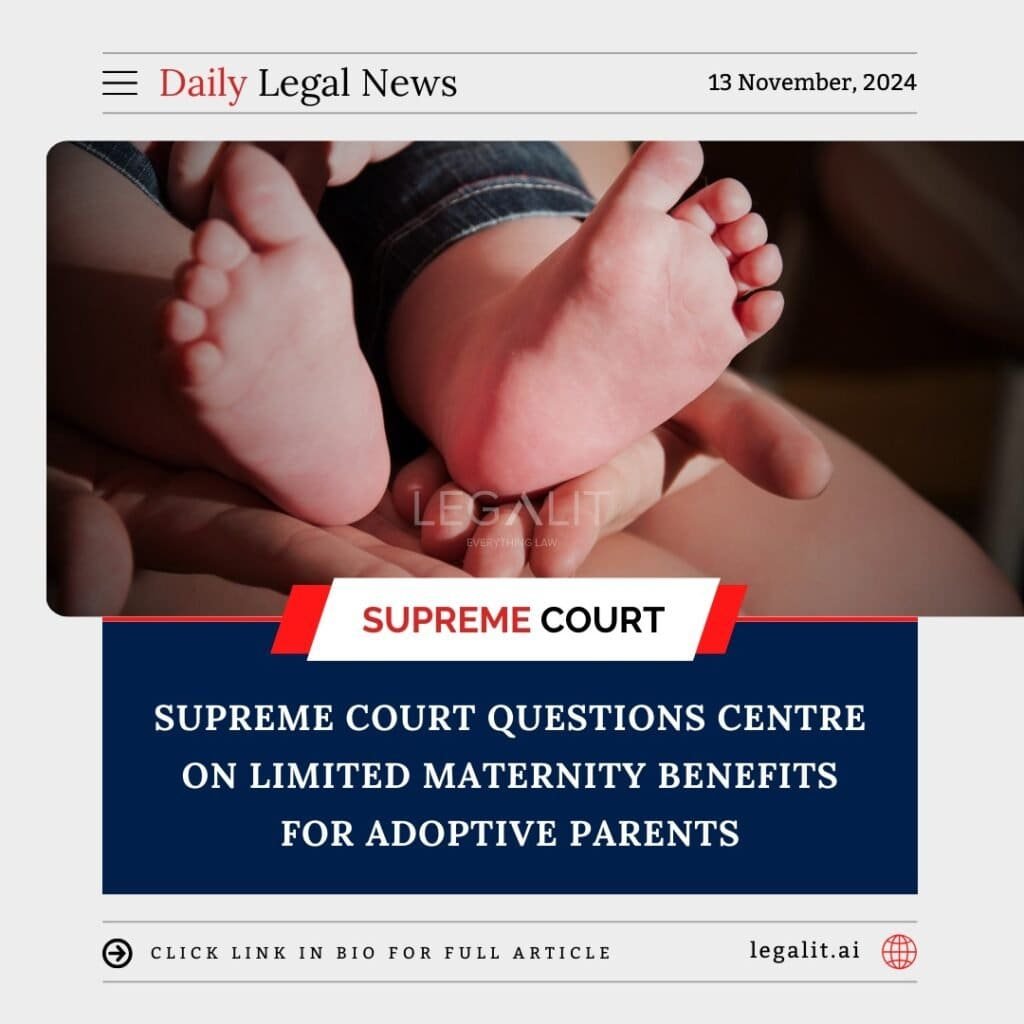
The Supreme Court recently raised concerns over the limited maternity benefits available to adoptive parents under Indian law, questioning the rationale behind the disparity in benefits compared to biological parents. The court’s observations highlight the need for a more inclusive approach in maternity leave policies to support adoptive parents.
Background:
Under the current Maternity Benefit Act, adoptive mothers are entitled to 12 weeks of leave if they adopt a child below the age of three months. In contrast, biological mothers are granted 26 weeks of maternity leave. This discrepancy has been criticized as discriminatory, with advocates arguing that adoptive parents also need ample time to bond with and care for their child. The Supreme Court took up the issue following petitions challenging the limited benefits for adoptive parents, pointing out the potential impact on child welfare and family integration.
Court’s Rationale:
During the proceedings, the Supreme Court questioned the Centre on the rationale behind restricting maternity benefits for adoptive mothers. The bench observed that adoptive parents require equal time and support to establish bonds with their children, especially during the initial months. The court expressed concern that the limited leave period does not account for the emotional and logistical adjustments that adoptive families face, urging the Centre to reconsider its policy to create parity with benefits extended to biological parents.
Existing Measures:
The Maternity Benefit Act grants 26 weeks of leave to biological mothers, recognizing the importance of maternity leave for the health of both mother and child. However, adoptive mothers and commissioning mothers (in cases of surrogacy) receive only 12 weeks. While some states and sectors have attempted to extend additional leave options, there is no uniform approach across the country, leaving adoptive parents at a disadvantage.
Conclusion:
The Supreme Court’s intervention signals a growing recognition of the need for inclusive family leave policies that accommodate diverse forms of parenthood. The court’s questioning of the Centre’s stance on adoptive maternity benefits may prompt reforms, fostering an environment where all parents, regardless of how they build their families, receive equal support to care for and bond with their children.
[ajax_load_more]