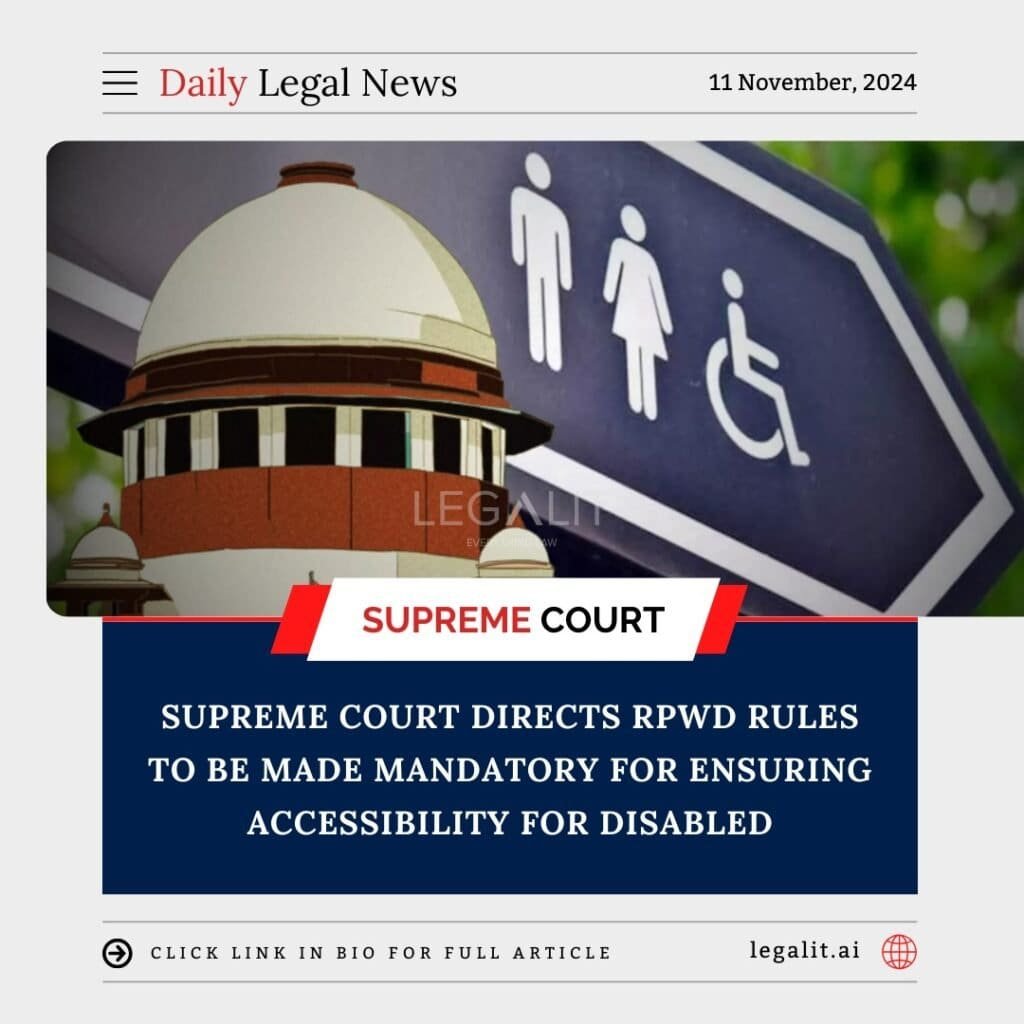
The Supreme Court of India has issued a directive to make the Rights of Persons with Disabilities (RPWD) Rules mandatory, emphasizing the need for accessible infrastructure and services to ensure equal rights and opportunities for persons with disabilities.
Background:
The RPWD Act of 2016 aims to provide comprehensive protection and promotion of the rights of persons with disabilities in India. The accompanying RPWD Rules are designed to enforce provisions for accessible public spaces, transportation, and communication. However, there have been concerns about the lack of implementation and adherence to these rules across various sectors. The Supreme Court’s intervention comes after recognizing the challenges faced by persons with disabilities in accessing basic public services and facilities.
Court’s Rationale:
The Supreme Court underlined that ensuring accessibility is not merely a matter of convenience but a fundamental right of individuals with disabilities under the Constitution of India. The court stated that failure to implement the RPWD Rules violates these rights and perpetuates discrimination. By making these rules mandatory, the court aims to promote inclusivity and equality, urging government bodies and private entities to prioritize accessibility in infrastructure, education, and employment.
Existing Measures:
While the RPWD Act mandates specific provisions for accessible design and services, the implementation of these rules has been inconsistent across states and institutions. The Court’s order stresses the need for strict enforcement, including regular monitoring and accountability, to ensure that persons with disabilities can fully participate in public life.
Conclusion:
The Supreme Court’s order to enforce the RPWD Rules marks a crucial step toward ensuring accessibility for disabled persons in India. It reflects a growing recognition of the rights of persons with disabilities and the urgent need to build a more inclusive society. The decision may encourage more stringent measures at both the state and national levels to bridge gaps in accessibility and enhance the quality of life for people with disabilities.
[ajax_load_more]