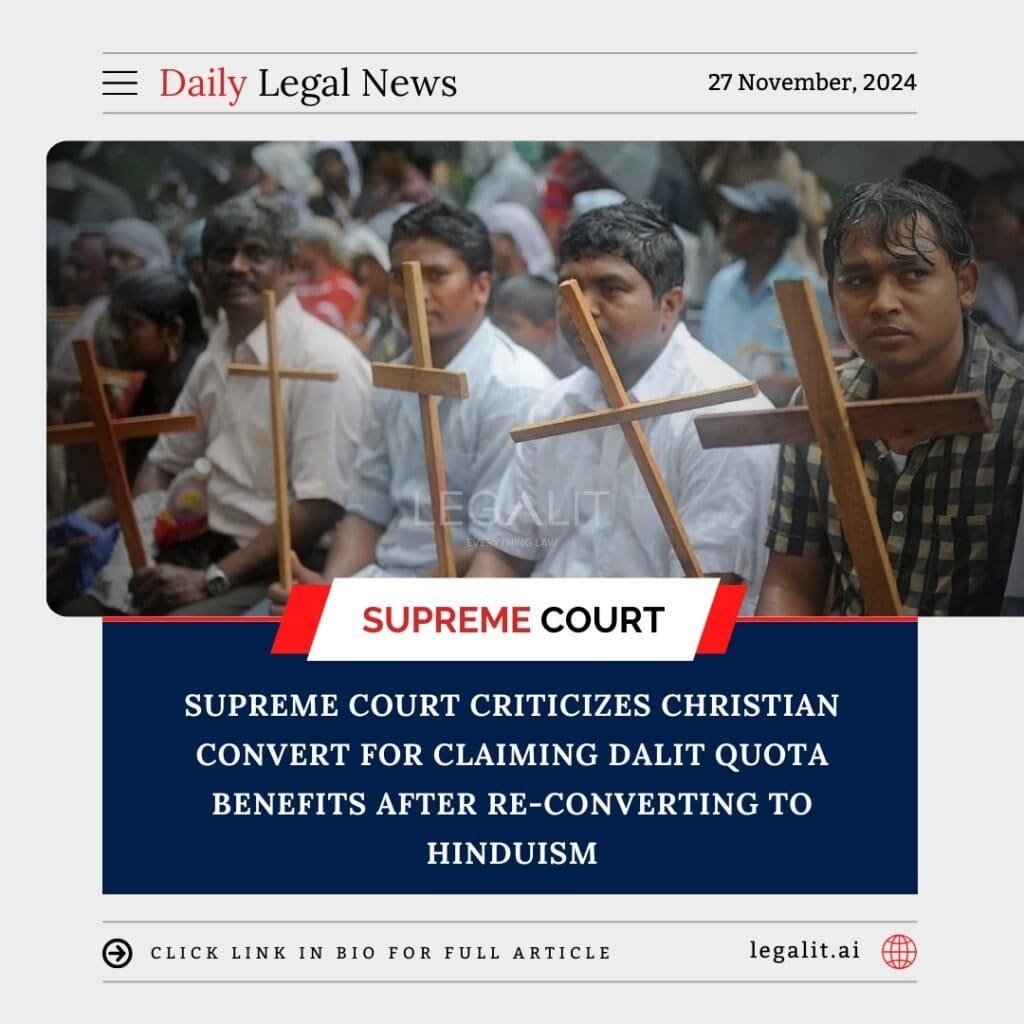
The Supreme Court of India has expressed strong disapproval of a Christian convert who re-embraced Hinduism to claim benefits reserved for Scheduled Castes (SC) under the Dalit quota. The court emphasized the misuse of constitutional provisions designed to uplift historically marginalized communities.
Background:
The petitioner, a person born into a Scheduled Caste family, had converted to Christianity, relinquishing the Dalit status under Indian law. However, after re-converting to Hinduism, the individual sought to reclaim the benefits accorded to Dalits, including reservations in education and employment. This led to a legal challenge questioning the legitimacy of such claims.
Court’s Rationale:
The Supreme Court observed that the primary objective of the Dalit quota system is to address the systemic discrimination faced by Scheduled Castes within the Hindu social hierarchy. It stated that a person who voluntarily embraced another religion cannot exploit the reservation system by re-converting solely for benefits. The bench noted that such actions dilute the intent of affirmative action policies and could open the door to widespread misuse.
Existing Measures:
Under Indian law, only individuals from Scheduled Castes practicing Hinduism, Sikhism, or Buddhism are eligible for SC benefits. The government has set criteria to verify claims of caste status, but legal loopholes have occasionally been exploited, necessitating judicial intervention.
Conclusion:
The Supreme Court’s criticism highlights the importance of preserving the sanctity of reservation policies meant for marginalized communities. The judgment reinforces the need for stringent scrutiny of caste-based claims to ensure that benefits are not misappropriated, protecting the integrity of affirmative action in India.
[ajax_load_more]