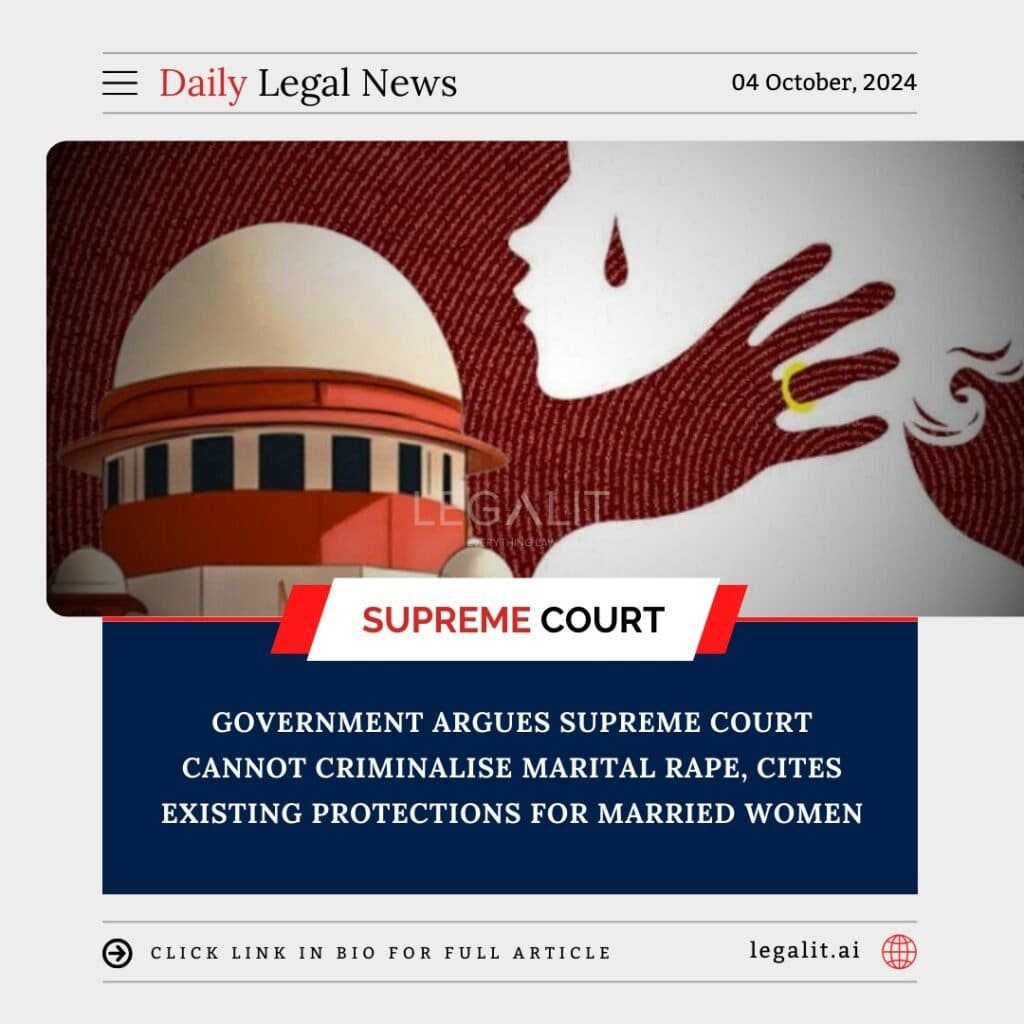
The ongoing debate about criminalising marital rape in India has taken a significant turn as the Centre argued before the Supreme Court that such an act cannot be deemed a criminal offence, emphasizing that existing laws already provide adequate protection for married women. This statement has sparked widespread discussions, highlighting the complexities surrounding marriage, consent, and the protection of women’s rights in India.
- Background of the Case
The debate over criminalising marital rape has been a long-standing issue in India. Marital rape is not recognized as a criminal offence under Indian law, owing largely to the exception provided under Section 375 of the Indian Penal Code (IPC), which states that sexual intercourse by a man with his wife is not considered rape if the wife is over 18 years of age. This exception has faced criticism from activists and legal experts for failing to acknowledge the right to bodily autonomy and consent within marriage. Several petitions have been filed in the Supreme Court, urging it to declare the marital rape exception unconstitutional. - Government’s Argument and Court’s Ruling
The Centre, in its recent submission to the Supreme Court, stated that criminalising marital rape could have far-reaching implications on the institution of marriage and could be misused to harass husbands. It emphasized that sufficient provisions are already in place under laws such as the Domestic Violence Act and Section 498A of the IPC, which protect married women from cruelty and abuse. The Centre argued that these existing legal frameworks offer adequate protection without necessitating the criminalisation of marital rape.
The Supreme Court, on its part, has expressed concern over the government’s stance, pointing out that consent should be the cornerstone of any sexual relationship, irrespective of marital status. The court has yet to deliver a final ruling on the matter, as the debate continues about balancing women’s rights with concerns regarding the potential misuse of such laws.
- Implications of the Government’s Position
The government’s argument against criminalising marital rape has significant implications for women’s rights, marriage, and the legal framework in India:
Rights and Autonomy: The refusal to criminalise marital rape undermines the right of married women to bodily autonomy and equal protection under the law. The absence of legal recourse for marital rape leaves many women vulnerable to sexual violence within their marriages.
Social Stigma and Reporting: The social stigma attached to marital rape, combined with the lack of criminal provisions, discourages many women from reporting sexual abuse by their spouses. This could lead to a continuation of abuse and a lack of recognition of their fundamental rights.
Potential for Misuse: The government has raised concerns about the potential misuse of marital rape laws to harass husbands. This highlights the delicate balance that must be struck between ensuring justice for genuine victims and preventing the misuse of laws.
- Need for Reforms in Legal Framework
The debate over criminalising marital rape has brought to light the need for reforms in India’s legal framework regarding marriage and women’s rights:
Recognition of Consent: Consent should be explicitly recognized as essential within marriage. The law must acknowledge that marriage does not grant an unfettered right to sexual relations without the spouse’s consent.
Awareness and Education: There is a need for increased awareness and education about the concept of marital rape and the importance of consent. Changing societal attitudes toward marital relationships is crucial for effective reform.
Comprehensive Legal Protection: Existing laws such as the Domestic Violence Act provide protection, but they do not adequately address the specific issue of marital rape. Reforms should ensure that married women have access to comprehensive legal protection against all forms of abuse, including sexual violence.
- Conclusion
The government’s argument that married women are already protected under existing laws and that marital rape should not be criminalised has reignited the debate over women’s rights, consent, and marriage in India. The absence of explicit legal recognition of marital rape continues to undermine the autonomy and dignity of married women. As the Supreme Court deliberates on this matter, the outcome will have far-reaching consequences for the legal framework of women’s rights in India. Ensuring that consent is respected in all circumstances, including within marriage, is essential to strengthening the rights and protection of women and promoting gender equality in society.
[ajax_load_more]