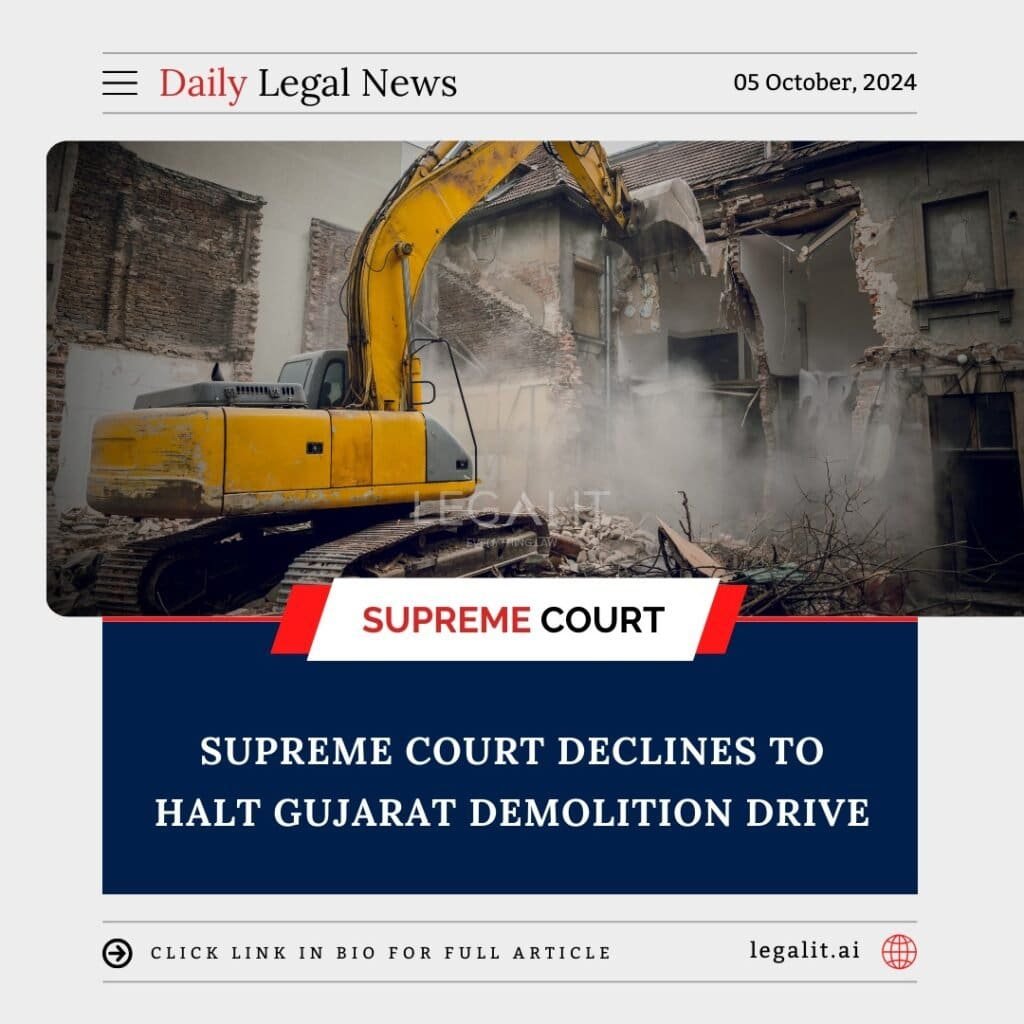
In a recent decision, the Supreme Court of India refused to intervene in a contentious demolition drive being carried out in Gujarat. The drive, which involves the razing of properties deemed unauthorized or illegal, has sparked protests and raised concerns over its implications for the residents affected by these demolitions. The apex court’s decision not to grant a stay order on the demolitions has left many questioning the legitimacy and humanitarian impact of the ongoing action.
- Background of the Demolition Drive
The Gujarat state government initiated a large-scale demolition campaign targeting illegal constructions in several cities and rural areas. The government argued that these structures were encroachments on public or government land and posed various risks, including to public safety and environmental concerns. According to state authorities, the campaign aims to restore public spaces and uphold the rule of law.
However, the demolition drive has been met with strong resistance from residents, activists, and civil society groups who argue that it is being conducted without adequate notice or due process. They claim that many of the demolished properties were homes to families who had been residing there for decades, often with valid claims or pending applications for regularization.
- Supreme Court’s Ruling and Reasoning
Petitions were filed in the Supreme Court seeking a stay on the demolition drive, primarily arguing that the action was disproportionately affecting marginalized communities and that the residents were not given sufficient time or alternatives for relocation. The petitioners also alleged that the drive was arbitrary and that it violated their right to shelter and dignity.
However, the Supreme Court refused to stay the demolition drive, stating that it would not interfere in state-level administrative decisions unless there was clear evidence of procedural violations or malafide intent. The bench emphasized the need for the enforcement of rules against illegal encroachments while highlighting that due process must be followed by the authorities.
The Court underscored that, in principle, no unauthorized construction could be allowed to remain indefinitely, especially when such structures posed safety concerns or impeded public welfare. The bench also noted that the petitioners could approach the appropriate high court if they had specific grievances related to the execution of the demolition process.
- Implications of the Judgment
The Supreme Court’s refusal to stay the demolition drive has far-reaching implications for the residents affected as well as for the approach taken by local authorities in similar actions:
Impact on Affected Residents: The ruling leaves residents facing immediate eviction without an alternative resettlement plan. Many of those affected belong to economically weaker sections, and their displacement may lead to severe socio-economic hardships.
Legal Precedent: The decision reinforces the principle that unauthorized constructions cannot be protected under the law. However, it also places the onus on state authorities to ensure that demolitions are carried out with respect to legal procedures, including adequate notice and arrangements for rehabilitation where applicable.
Administrative Leeway: The ruling allows state administrations more freedom to take action against illegal structures, which could potentially deter future encroachments. However, it also raises concerns about the arbitrary exercise of power, particularly when such actions target vulnerable communities.
- Calls for Reform in Urban Planning and Housing Rights
The situation in Gujarat points to the broader issue of urban planning and the rights of residents to adequate housing:
Need for Clearer Regulations: There is a pressing need for clearer regulations that distinguish between encroachments that genuinely impede public welfare and those that are the result of administrative failures in urban planning. The government must provide affordable housing solutions to prevent the proliferation of unauthorized colonies.
Focus on Rehabilitation: Demolition drives should be accompanied by robust rehabilitation plans for affected residents, especially those belonging to marginalized communities. Adequate relocation and compensation are essential to ensure that such actions do not lead to human rights violations.
Transparency in Demolition Actions: Transparency and accountability are crucial in demolition actions. Authorities should provide proper notices, engage with the residents, and establish clear criteria for selecting properties for demolition. Independent oversight could help prevent potential misuse of power.
Conclusion
The Supreme Court’s decision to refuse a stay on the Gujarat demolition drive highlights the ongoing tension between enforcing urban regulations and ensuring the rights and welfare of affected residents. While the need for action against illegal constructions is recognized, there must also be an emphasis on due process, transparency, and a humane approach to rehabilitation.
For India to address the root causes of unauthorized constructions, it must focus on urban planning reforms that provide affordable and accessible housing options, ensuring that the economically weaker sections do not resort to settling in unregulated areas. Balancing the enforcement of law with compassion for the displaced will be key to fostering an equitable and lawful urban landscape.
[ajax_load_more]