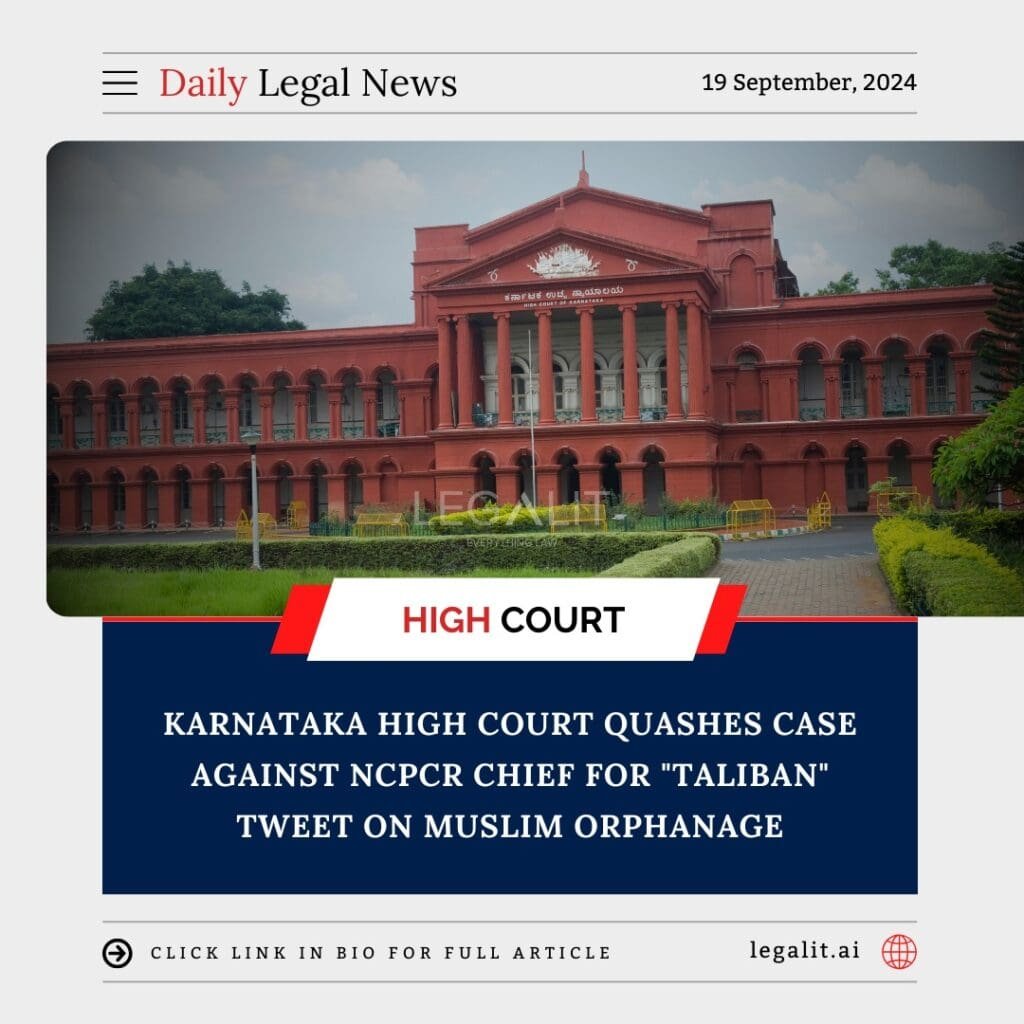
In a significant ruling, the Karnataka High Court quashed a case filed against *Priyank Kanoongo, the chairperson of the **National Commission for Protection of Child Rights (NCPCR), for his controversial tweet in which he allegedly compared a Muslim orphanage to the **Taliban. The court’s decision to set aside the charges brought against the NCPCR chief underscores the legal complexities surrounding *free speech on social media and the boundaries of public discourse, especially when it involves sensitive religious and communal issues.
Background of the Case
The case stemmed from a tweet made by Priyank Kanoongo, who had visited a Muslim orphanage in Karnataka during an investigation. Following his visit, Kanoongo reportedly posted a tweet drawing parallels between the orphanage’s operations and the practices of the Taliban, suggesting a radical influence within the institution. This tweet sparked outrage from several quarters, with community leaders and activists accusing Kanoongo of promoting hatred and spreading misinformation.
Subsequently, a complaint was filed against Kanoongo under sections of the Indian Penal Code (IPC) dealing with *hate speech, **promoting enmity between different groups, and *hurting religious sentiments. The police registered a First Information Report (FIR) against him, triggering legal action.
Karnataka High Court’s Ruling
The Karnataka High Court, after reviewing the case, decided to quash the FIR and charges filed against Kanoongo. The court’s key observations in its decision included:
- Free Speech Protection: The court underscored the importance of freedom of speech and expression, particularly when it concerns public officials carrying out their duties. While recognizing that Kanoongo’s tweet was provocative, the court ruled that it fell within the purview of free speech and was not intended to incite violence or hatred. It emphasized that *social media posts must be interpreted with caution, especially in the context of public discourse.
- No Evidence of Intent to Incite Hatred: The court found that the tweet did not meet the legal criteria for promoting enmity or hurting religious sentiments. It concluded that while the language used by Kanoongo was critical, there was no intent to provoke communal disharmony or incite violence. The court noted that officials like Kanoongo often express strong opinions in the course of their duties and that such expressions should not be criminalized unless they clearly violate the law.
- Judicial Restraint in Political and Social Commentary: The ruling also highlighted the need for judicial restraint in matters of political or social commentary, particularly when public officials are involved. The court acknowledged that public figures, including heads of government commissions, are often at the center of controversies and face criticism for their statements. However, it stressed that the legal system should not be misused to suppress legitimate criticism or commentary, even if it is contentious.
Implications of the Ruling
The Karnataka High Court’s decision to quash the case against the NCPCR chief has broader implications for the limits of free speech and public accountability in India:
- Free Speech on Social Media: This ruling is likely to influence future cases involving social media posts by public officials or individuals in positions of power. It reaffirms the right to free expression, even if such speech is critical or controversial, as long as it does not explicitly incite hatred or violence.
- Balancing Accountability and Free Expression: The decision highlights the challenge of balancing the need for public officials to be accountable for their statements while protecting their right to express opinions in their official capacities. The court’s emphasis on judicial restraint could discourage the filing of frivolous cases aimed at silencing critical voices in the public sphere.
- Sensitive Religious Issues: While the court’s ruling supports free speech, it also serves as a reminder that religious and communal sensitivities must be handled with care in public discourse. The controversy over the “Taliban” tweet demonstrates how comments, especially those related to religious institutions, can spark backlash and lead to legal battles, even if the intent behind them is not malicious.
Conclusion
The Karnataka High Court’s decision to quash the case against Priyank Kanoongo for his “Taliban” tweet on a Muslim orphanage represents an important legal precedent in the ongoing debate over free speech and social media commentary in India. By protecting the NCPCR chief’s right to express his views, the court has reinforced the principle that public officials, while accountable, should not be criminally prosecuted for critical opinions unless clear evidence of wrongdoing is established. The ruling underscores the importance of safeguarding free expression while ensuring that public discourse remains respectful and does not cross into unlawful territory.
[ajax_load_more]