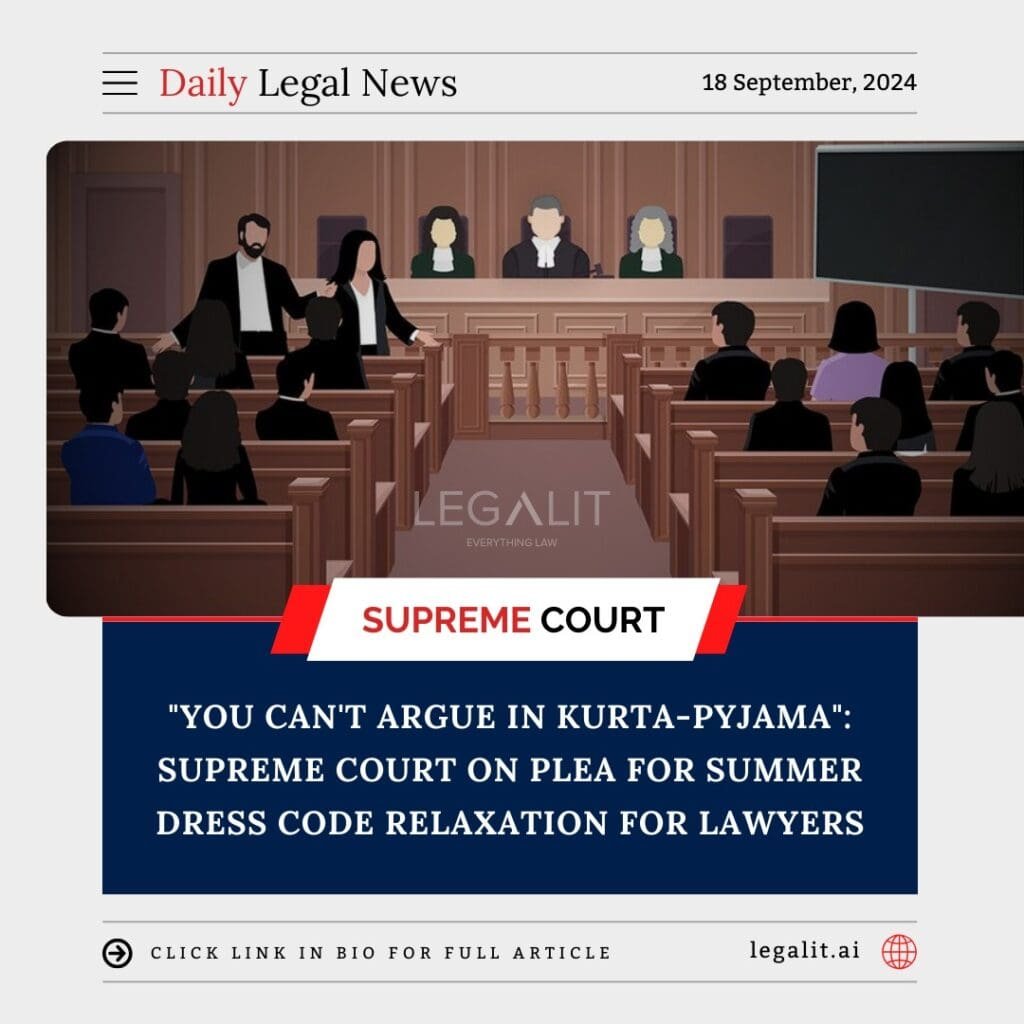
In a recent hearing, the Supreme Court of India made headlines by rejecting a plea seeking relaxation of the prescribed dress code for lawyers during the summer months. The plea, which called for allowing more casual attire like kurta-pyjama for lawyers due to extreme heat, was firmly dismissed by the court. The bench, emphasizing the need for maintaining decorum in the legal profession, remarked that lawyers cannot argue in casual wear like kurta-pyjama and that professional attire is an essential part of court protocol.
The Plea for Dress Code Relaxation
The plea was filed in response to the difficulties faced by lawyers, particularly during the sweltering summer months when the traditional lawyer’s attire—consisting of a black coat, gown, and neckband—can be uncomfortable and impractical in India’s extreme heat. The petitioner argued that given the climatic conditions in several parts of India, particularly in the summer, the dress code should be relaxed to allow for lighter, more comfortable clothing such as kurta-pyjama.
The petitioner pointed out that the current dress code, which requires lawyers to wear black and white, was established during colonial times and may no longer be suitable for modern-day India. The plea also suggested that maintaining the traditional dress code during extreme weather conditions could negatively impact lawyers’ health and overall well-being.
Supreme Court’s Rationale
While acknowledging the concerns raised about the discomfort of wearing formal attire in the summer, the Supreme Court maintained that the dress code is an integral part of the legal profession. Here’s what the court emphasized:
- Professional Decorum: The court reiterated that the prescribed dress code helps maintain the professional decorum and seriousness of legal proceedings. A lawyer’s attire is not merely a matter of personal preference but a reflection of the dignity and discipline of the legal profession. The court emphasized that maintaining formality in attire is key to upholding the sanctity of court proceedings.
- Uniformity and Equality: The bench also pointed out that the uniform dress code ensures equality among lawyers, removing any distinctions based on appearance or attire. Allowing deviations such as kurta-pyjama, which can vary in style, could lead to inconsistencies and reduce the sense of unity among lawyers in court.
- Traditional Values and Legal Heritage: The court underscored the importance of preserving certain traditions within the legal system, including the dress code. The formal black-and-white attire is symbolic of the legal profession’s heritage and conveys a sense of seriousness and impartiality in the eyes of the public and clients alike.
Implications for the Legal Profession
- Maintaining Tradition vs. Practicality: The ruling highlights the ongoing tension between maintaining long-standing traditions in the legal profession and adapting to practical realities such as extreme weather conditions. While the court has chosen to uphold tradition, the debate around the practicality of the dress code may continue in the legal community, particularly as issues related to climate and comfort become more pressing.
- Future Discussions on Dress Code: Although the Supreme Court dismissed the plea, the ruling opens the door for future discussions on whether the legal profession can adapt its dress code to meet the needs of modern-day practitioners. While formal attire is deeply ingrained in legal traditions, there could be room for future debates on making small adjustments, particularly in regions with extreme weather.
- Health and Well-Being Concerns: The dismissal of the plea does not resolve the legitimate concerns raised about the health and well-being of lawyers who must wear heavy formal clothing in high temperatures. The legal community may explore other ways to address these concerns, such as advocating for better climate control in courtrooms or considering alternative fabrics for formal wear.
Conclusion
The Supreme Court’s firm stance on the issue reflects the importance it places on maintaining the formal decorum of the legal profession. While acknowledging the discomfort caused by the prescribed attire in extreme heat, the court ruled that professional dress standards cannot be compromised. The decision reinforces the significance of tradition and uniformity in the legal system, but it also leaves open the question of how the profession might evolve to address the practical challenges of its members in the future.
[ajax_load_more]