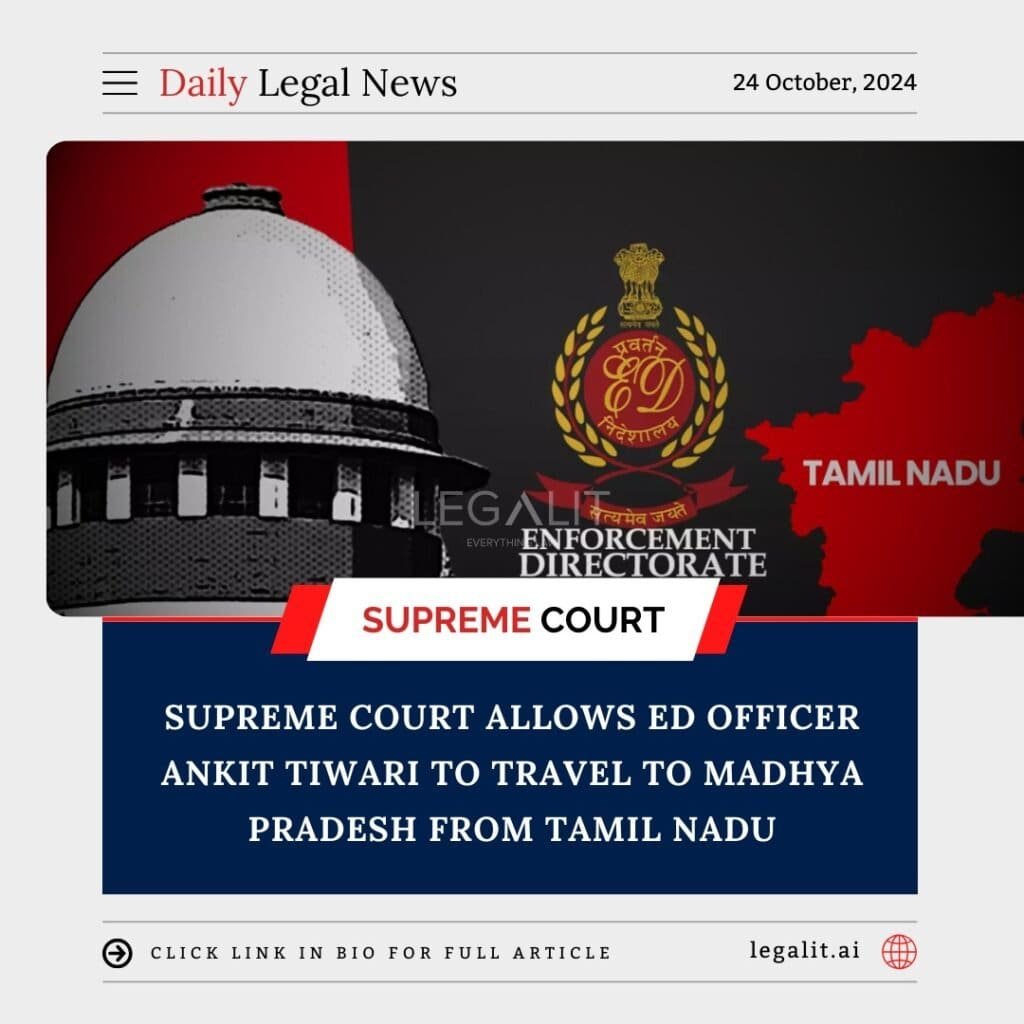
The Supreme Court of India has granted permission to Enforcement Directorate (ED) officer Ankit Tiwari to travel from Tamil Nadu to Madhya Pradesh for a specific duration. This decision comes amidst ongoing investigations concerning a case linked to alleged money laundering and other financial irregularities.
Background
Ankit Tiwari has been involved in high-profile investigations as part of the ED, which is tasked with enforcing economic laws and combating financial crimes in India. The request for travel arose as part of his official duties and personal circumstances, prompting the need for judicial intervention to facilitate his movement across states.
Court’s Rationale
The Supreme Court emphasized the necessity of balancing the officer’s professional responsibilities with his personal needs. The bench noted that travel restrictions can hinder the effective functioning of law enforcement officials, especially when their duties necessitate mobility. Therefore, allowing Tiwari to travel is viewed as essential for maintaining operational efficiency while ensuring compliance with legal requirements.
Implications
This ruling not only underscores the importance of enabling law enforcement officials to perform their duties without undue hindrances but also reflects the court’s commitment to ensuring that legal processes do not obstruct the execution of justice. The decision may set a precedent for similar requests in the future, reinforcing the need for flexibility in the movement of officials engaged in critical investigations.
Conclusion
The Supreme Court’s decision to allow Ankit Tiwari to travel highlights the ongoing balance between law enforcement obligations and personal freedoms. As the ED continues to address significant cases of financial misconduct, facilitating the movement of its officers is crucial for the effective enforcement of laws in India.
[ajax_load_more]